
1 month ago · 7 min read
How I Think About Stripe Payment Flows in Product Backends
A practical blueprint for payment flows: checkout state, idempotent webhooks, subscription access, grace periods, and operational debugging.
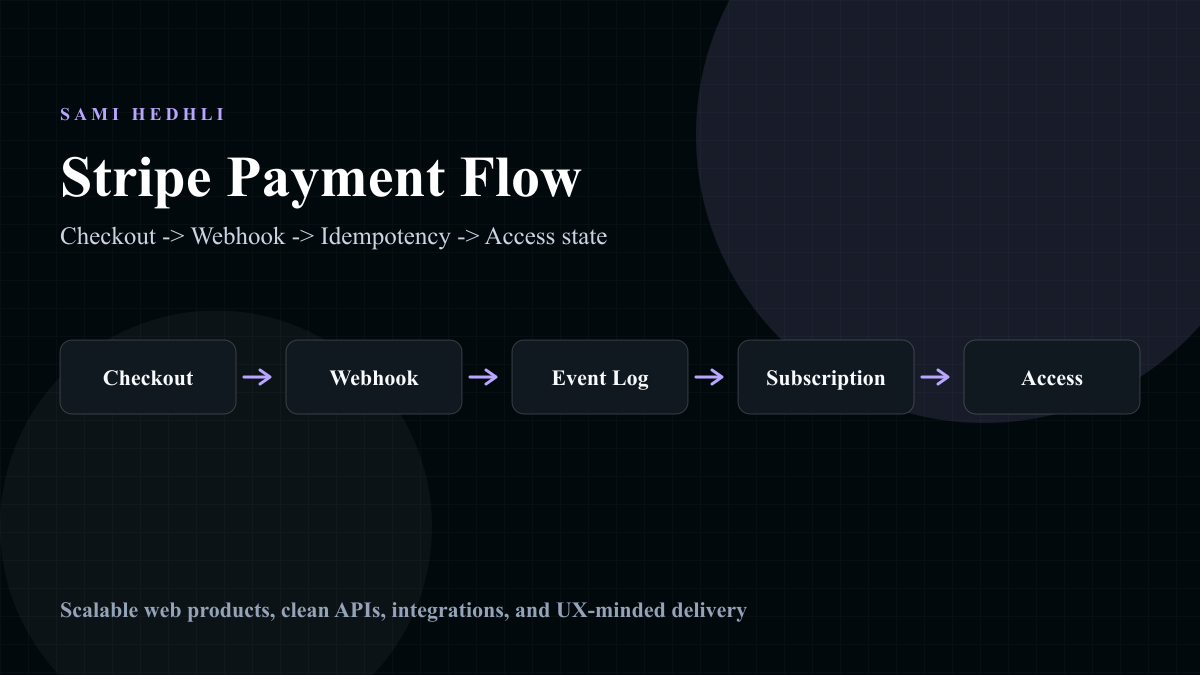
Payments are state machines
A reliable Stripe integration starts by treating billing as a state machine, not as a checkout button. The product needs to know what happens when a customer starts checkout, abandons it, succeeds, fails, retries, changes plan, cancels, or enters a grace period.
The backend should not trust a browser return URL as the source of truth. The return URL is useful for UX, but webhooks should drive durable payment state because they represent what the payment provider actually processed.
Store your own product state
Stripe has its own objects, but the product still needs its own state. I usually want explicit records for customer identity, subscription status, invoice or payment status, access expiry, plan, cancellation state, last payment attempt, and external identifiers for reconciliation.
Make webhooks idempotent
Webhook processing should expect repeated events and imperfect ordering. I like storing event IDs, processing status, payload metadata, and the product records affected by the event. If the same event arrives twice, the second pass should be harmless.
Plan for access, grace, and recovery
Payment systems are full of uncomfortable states: payment failed, invoice open, card expired, cancellation scheduled, subscription past due, account in grace period, webhook delayed, or provider dashboard changed by an admin. The product needs clear behavior for each one.
A practical checklist
For payment flows, I check that checkout creation is tied to a product record, webhook events are logged, processing is idempotent, access state is explicit, failed payment states have user-facing copy, and support can reconcile a customer without reading raw logs.
Where this shows up in my work
This thinking connects directly to my AI product backend case study, where payment eligibility and service behavior had to stay separate from the AI workflow itself.
FAQs
Should the checkout return URL update product access?
No. The return URL can improve UX, but webhook processing should be the source of truth for durable payment and subscription state.
Related work
Related articles
Adding AI Features Without Turning the Product Into a Demo
How to structure AI product features around service boundaries, queues, rate limits, state, and failure handling so they survive real users.
How I Approach Maintainable Laravel Product Backends
A practical way to structure Laravel product backends around workflows, thin controllers, transactions, queues, and readable domain code.